Categories: Adjectives

Commonly Misused Adjectives and Its Easy Solution | Adjectives Ending in Ing and Ed


The Difference between Adjectives Ending in Ing and Ed

Adjectives ending in -ing and -ed have different meaning. Ing adjectives cause us to have the feeling of something whereas ed adjectives are what we feel.

These two types of adjectives are also known as participial adjectives. The verb ending in ing is called present participle. And, the verbs ending in ed, including all the verbs III, are called past participle. Both of them can function as adjectives and we call them participial adjectives.


Adjectives Ending in Ing and Ed Examples

Let’s see the following examples:

Boring versus Bored

Sue has been doing the same job for a very long time. Every day she does exactly the same thing again and again. She doesn’t enjoy it any more and would like to do something different.
Sue’s job is boring.
Sue is bored (with her job).
Someone is -ed if something (or someone) is ing. or, if something is -ing, it makes you -ed. So:
Sue is bored because her job is boring.
Sue’s job is boring, so Sue is bored. ( not ‘ Sue is boring’)

Interesting versus Interested

Someone is interested because something  (or someone) is interesting.
Paul is interested in music.  (not  ‘interesting in music’)
Paul finds music interesting.
Are you interested in buying the house?
Did you meet anyone interesting at the party?

Surprising versus Surprised

Someone is surprised because something is surprising.
Everyone was surprised that the boy could lift up that heavy stone.
It was quite surprising that the boy could lift up that heavy stone.

Disappointing versus Disappointed

Someone is disappointed because something is disappointing.
The coach was disappointed with the team’s performance. He expected it to play much better.
The team’s performance was disappointing. The coach expected it to play much better.

Tiring versus Tired

Someone is tired because something is tiring.
He is always very tired when he gets home from work.
He has a very tiring job.

Conclusion

After we compare those two types of adjectives, we can conclude that:
  1. Adjectives ending in ing cause us to have the feeling of something.
  2. Adjectives ending in ed is the feeling we have. The adjectives that we feel.
For your reference, we provide you with the most popular adjectives ending in ‘ing’ and ‘ed’.
Ing Adjectives Ed Adjectives
fascinating
exciting
amusing
amazing
astonishing
shocking
disgusting
embarrassing
confusing
horrifying
terrifying
frightening
depressing
worrying
annoying
exhausting
satisfying
fascinated
excited
amused
amazed
astonished
shocked
disgusted
embarrassed
confused
horrified
horrified
frightened
depressed
worried
annoyed
exhausted
satisfied

Adjective Ending in ed and ing Exercise

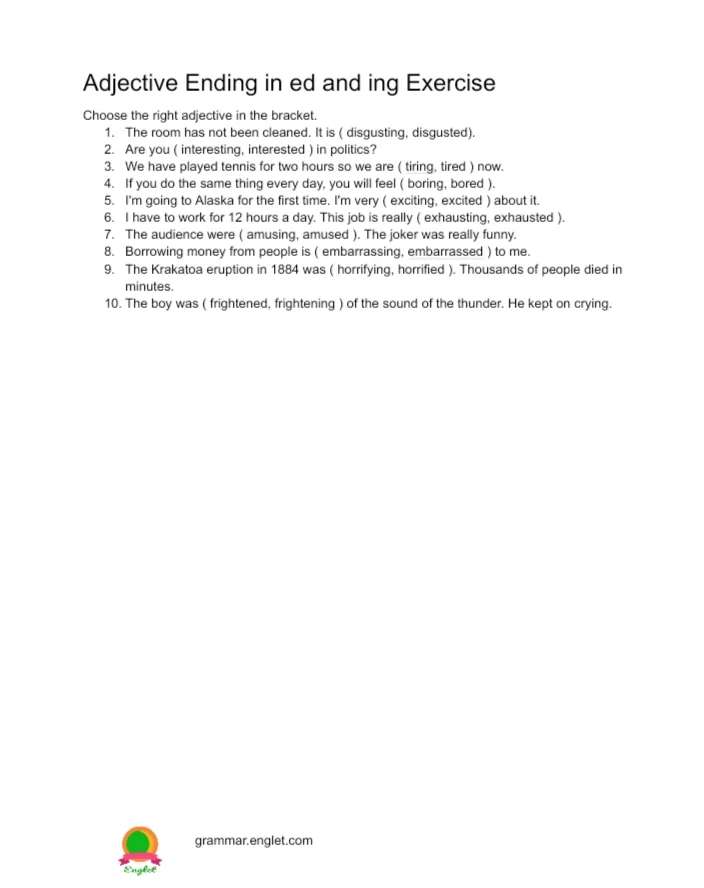
Exercise I  | Adjective Ending in ed and ing Exercise

Choose the right adjective in the bracket.
  1. The room has not been cleaned. It is ( disgusting, disgusted).
  2. Are you ( interesting, interested ) in politics?
  3. We have played tennis for two hours so we are ( tiring, tired ) now.
  4. If you do the same thing every day, you will feel ( boring, bored ).
  5. I’m going to Alaska for the first time. I’m very ( exciting, excited ) about it.
  6. I have to work for 12 hours a day. This job is really ( exhausting, exhausted ).
  7. The audience were ( amusing, amused ). The joker was really funny.
  8. Borrowing money from people is ( embarrassing, embarrassed ) to me.
  9. The Krakatoa eruption in 1884 was ( horrifying, horrified ). Thousands of people died in minutes.
  10. The boy was ( frightened, frightening ) of the sound of the thunder. He kept on crying.


Exercise II | Adjective Ending in ed and ing Exercise

Complete each sentence with correct adjective provided.


disgusting boring terrifying interested  interesting bored boring


  1. His speech was ___________ . Nobody paid attention to it.
  2. The picture of a ghost is __________. Everyone in the room closed their eyes.
  3. My little sister is not ___________ in music but she loves drawing pictures.
  4. You look __________ Let’s go to the party.
  5. Football is not __________ to me. Instead, I often play table tennis.
  6. The toilet is so ___________ . It seems nobody ever cleans it.

Answer

Exercise I

  1. The room has not been cleaned. It is disgusting.
  2. Are you interested  in politics?
  3. We have played tennis for two hours so we are tired now.
  4. If you do the same thing every day, you will feel bored.
  5. I’m going to Alaska for the first time. I’m very excited  about it.
  6. I have to work for 12 hours a day. This job is really exhausting.
  7. The audience were amused. The joker was really funny.
  8. Borrowing money from people is embarrassing to me.
  9. The Krakatoa eruption in 1884 was horrifying. Thousands of people died in minutes.
  10. The boy was frightened of the sound of the thunder. He kept on crying.


Exercise II


  1. His speech was boring. Nobody paid attention to it.
  2. The picture of a ghost is terrifying. Everyone in the room closed their eyes.
  3. My little sister is not interested in music but she loves drawing pictures.
  4. You look bored . Let’s go to the party.
  5. Football is not interesting to me. Instead, I often play table tennis.
  6. The toilet is so disgusting. It seems nobody ever cleans it.


Download the exercise in Google Drive.


Adjective Ending in ed and ing Worksheet

Get this exercise to improve your knowledge about ing adjectives and ed adjectives.


admin

View Comments

Recent Posts

Three Advices about Past Future Perfect Tense | Exercises with Answers

The English language is renowned for its 16 different tenses, each serving a specific purpose…

2 years ago

What Everybody Ought to Know about Past Future Continuous: Exercises with Answers

In English grammar, tenses play a crucial role in conveying the timing and progression of…

2 years ago

Understanding the Past Future in Minutes: Exercises with Answers

One aspect of English grammar is the past future tense, a tool for discussing actions…

2 years ago

Understanding Linking Verbs in Two Minutes: Exercises with Answers

Linking verbs are an essential component of the English language, serving as the bridge between…

2 years ago

Four Essential Sentence Structures to Enhance Your Writing Skills

Every piece of writing, no matter how eloquent, lives or dies based on its structure.…

3 years ago

Honing Your Production Skills by Using the Power of Modifying Adverbial Phrases

Have you taught your students modifying adverbial phrases? If not, why don't you use the…

3 years ago

This website uses cookies.