We can use adjectives to infinitive in two ways. Let’s see both of them.
- It is difficult to understand her.
- She’s difficult to understand.
- It’s good to see you again.
- I’m happy to see you again.
- Are you happy to see me again?
- Yes, It’s pleasing to talk to you again.
- Was it pleasant to sleep alone in this large house?
- No, it was scary to stay all night alone here.
1. Adjectives to Infinitive Pattern I Examples
- It is almost impossible to do his idea.
- It is safe to eat this leaf.
- Is it okay to for me to sit here?
- It is very interesting to talk to Sue.
- Is it polite to blow your nose in the dining table?
Here are the adjectives we can use in the pattern above.
- difficult
- easy
- impossible
- hard
- interesting
- impossible
- safe
- polite
- okay
2. Adjectives to Infinitive Pattern II Examples
- His idea is almost impossible to do.
- This leaf is safe to eat.
- Sue is very interesting to talk to.
- This house is scary to live in.
- These fruits are safe to eat.
3. To Infinitive After Ordinal Numbers
We use to + infinitive after ordinal numbers (the first, the second, the third etc.) and also after the next and the last. Let’s see the following examples.
- Who was the first man to walk on the moon?
- She’s the last girl to stay in my heart.
4. Adjectives to Infinitive | Expressing One’s Feeling about Something
We can use to + infinitive after the following adjectives to say how someone feels about something.
- happy
- glad
- pleased
- sad
- disappointed
- relieved
- amazed
- astonished
Let’s see the following examples.
- I am sorry to hear that your son is ill.
- She was surprised to find her lost kitten.
- His parents were disappointed to see his bad performance.
5. Adjectives of Someone to Do Something
The structure (it is) nice of someone to do something is possible after the following adjectives.
- nice
- kind
- mean
- stupid
- silly
- clever
- polite
- careless
- generous
Let’s see the following examples.
- It was nice of you to bring me these beautiful flowers. Thank you very much.
- It was careless of Akhmad to drive the car beyond the speed limit.
- It’s stupid of him to leave that smart beautiful girl.
- It was very generous of you to lend us the money.
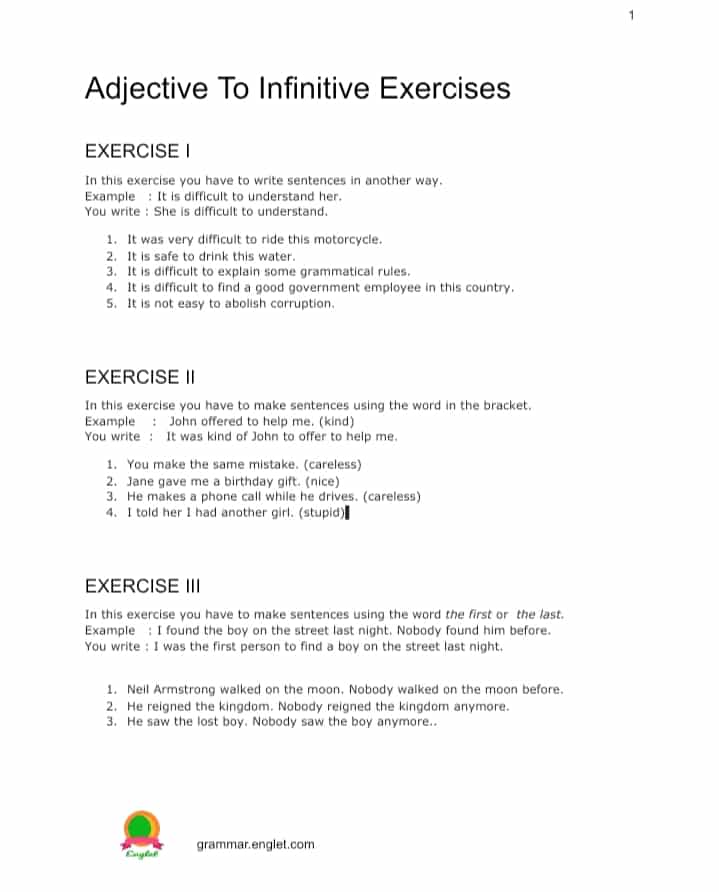
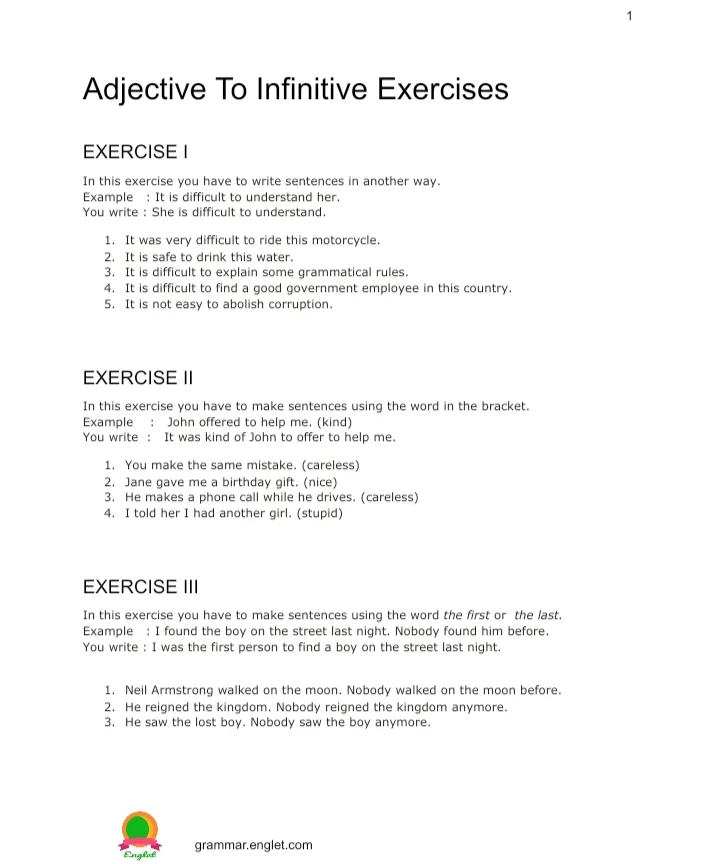
Exercise I
In this exercise you have to write sentences in another way.
Example : It is difficult to understand her.
You write : She is difficult to understand.
- It was very difficult to ride this motorcycle.
- It is safe to drink this water.
- It is difficult to explain some grammatical rules.
- It is difficult to find a good government employee in this country.
- It is not easy to abolish corruption.
Exercise II
In this exercise you have to make sentences using the word in the bracket.
Example : John offered to help me. ( kind )
You write : It was kind of John to offer to help me.
- You make the same mistake. (careless)
- Jane gave me a birthday gift. (nice)
- He makes a phone call while he drives. (careless)
- I told her I had another girl. (stupid)
Exercise III
In this exercise you have to make sentences using the word the first or the last.
Example : I found the boy on the street last night. Nobody found him before.
You write : I was the first person to find boy on the street last night.
- Neil Armstrong walked on the moon. Nobody walked on the moon before.
- He reigned the kingdom. Nobody reigned the kingdom anymore.
- He saw the lost boy. Nobody saw the boy anymore.
Answer
Exercise I
- This motorcycle is very difficult to ride.
- This water is safe to drink.
- Some grammatical rules are difficult to explain.
- A good government employee is difficult to find in this country.
- Corruption is not easy to abolish.
Exercise II
- It is careless of you to make the same mistake.
- It was nice of Jane to give me a birthday present.
- It is careless of him to make a phone call while he drives.
- It was stupid of me to tell her I had another girl.
Exercise III
- Neil Armstrong was the first man to walk on the moon.
- He was the last person/king to reign the kingdom.
- He was the last person to see the boy.



View Comments
This is a very helpful explanation with rexamples. Thank You.
I am Alicja. Thank you for this explanation and examples.
Thank you.
Thank you.
I have been browsing online greater than three hours today, but I never discovered any attention-grabbing article like yours. It is beautiful value enough for me. Personally, if all web owners and bloggers made good content as you probably did, the net can be a lot more helpful than ever before.