He used to smoke means that he smoked regularly for some time in the past, but he doesn’t smoke now :
We use used to with the infinitive (used to do/ used to smoke etc.) to say that something regularly happened in the past but no longer happens. Let’s see the following examples :
We also use used to for past situations (which no longer exist). Let’s see the following examples :
Used to + infinitive is always past. There is no present. You
cannot say ‘I use to do’. For the present ‘ use the present simple (I do). Let’s see the following examples !
| Past | Present |
| He used to smoke. I used to live in Saint Thomas. There used to be …. | He smokes. I live in Halifax. There is ….. |
The normal question form is did … use to …? Let’s see the following examples :
The negative form is didn’t use to … (or ‘used not to’). Let’s see the following examples :
Be careful not to confuse I used to do and I am used to doing. Structures and meanings are different. Let’s see the following examples !
See active and passive voice exercises here.
The difference between used to and be used to is that used to is for habits in the past while be used to is for a new habit. Be used to is used to express that we are accustomed to something or new activities. This activities must be a noun or a gerund (verb+ing).
See the following examples:
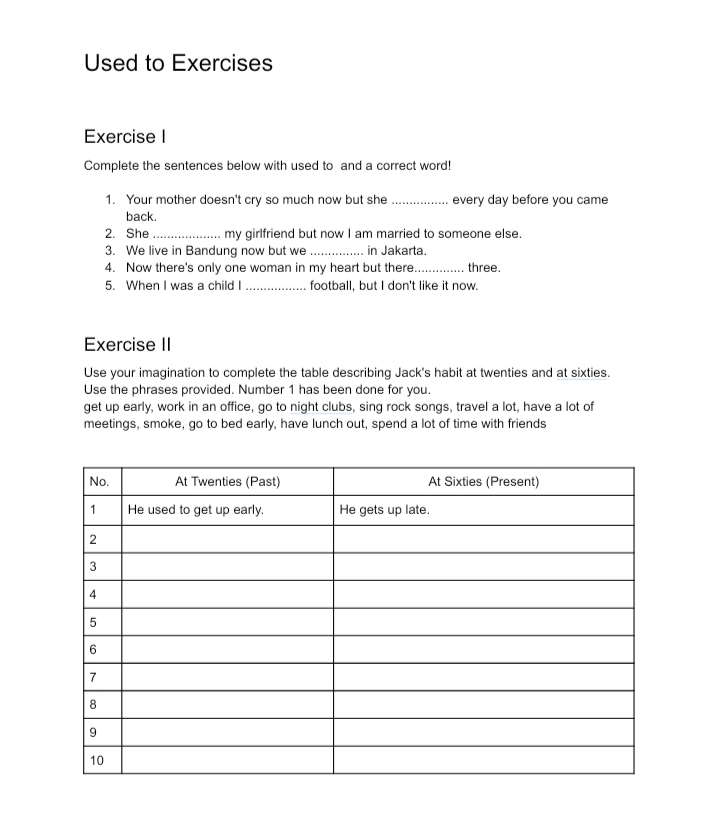
Complete the sentences below with used to and a correct word!
| At Twenties (the past) | At Sixties (now) |
|---|---|
|
|
Answer the following questions about your past habit.
Complete the sentences with the correct word form in the box.
| eat | smoke | live |
| ski | dance | live |
| At Twenties (the past) | At Sixties (now) |
|---|---|
| 1. He used to get up early. 2. He used to work in an office. 3. He used to go to night clubs. 4. He used to sing rock songs. 5. He used to travel a lot. 6. He used to have a lot of meeting. 7. He used to smoke. 8. He never used to go to bed early. 9. He used to have lunch out. 10. He used to spend a lot of time with friends. | 1. He gets up late. 2. He doesn’t work anymore. 3. He stays at home at night. 4. He doesn’t sing any songs. 5. He stays at home a lot. 6. He hardly has a meeting. 7. He doesn’t smoke. 8. He goes to bed early. 9. He has lunch at home. 10. He spends a lot of time with his wife. |
Different answers are possible.
The English language is renowned for its 16 different tenses, each serving a specific purpose…
In English grammar, tenses play a crucial role in conveying the timing and progression of…
One aspect of English grammar is the past future tense, a tool for discussing actions…
Linking verbs are an essential component of the English language, serving as the bridge between…
Every piece of writing, no matter how eloquent, lives or dies based on its structure.…
Have you taught your students modifying adverbial phrases? If not, why don't you use the…
This website uses cookies.

View Comments