Hello Everyone. Have you ever used “used to + ing” in your English communication activities? Yes, you are right. We often have to use this pattern when we communicate with others. But, do you know the meaning of the pattern? See info below if you are not sure.
Used to + Ing Meaning
“I’m used to something/verb + ing” means it is not new or strange for me to something/to verb + ing. Let’s see the following examples.
- Igor lives alone. He doesn’t mind this because he has lived alone for 15 years. So he is used to it. He is used to living alone.
- My new shoes felt a bit strange at first because I wasn’t used to them.
- Our new flat is on a very busy street. I expect we’ll get used to the noise but at the moment we find it very disturbing.
- Fred has a new job. He has to get up much earlier at 6.00. He find this difficult at present because he isn’t used to getting up so early .
- Igor is used to living alone. (not Igor is used to live alone.)
The Difference Between used to + infinitive and used to + ing/something.
Do not confuse I am used to doing with I used to do. They are different in structure and in meaning. to be used to + ing means isn’t strange for me.
- I am used to (doing)something.
- She is used to the weather in this country
- Susan is used to driving on the left because I’ve lived in Britain for a long time.
I used to do something means that I did something regularly in the past. You can ‘t use this structure for the present. Let’s see the following examples.
- These days I usually stay in bed until late. But when I had a job, I used to get up early.
- When I was single, I used to walk very fast. Now I don’t. My wife walks very slowly.
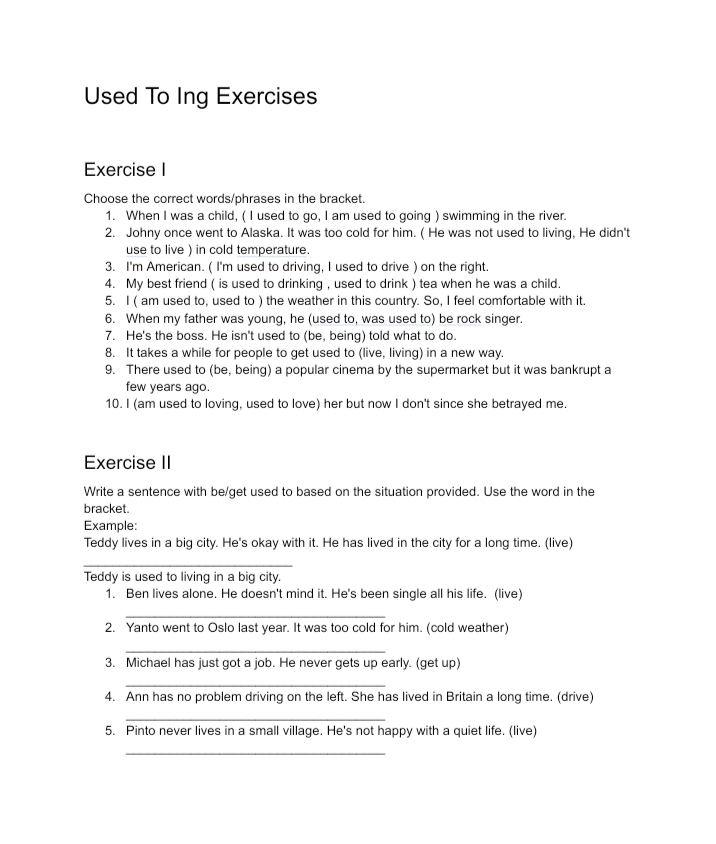
Used To Ing Exercises
Exercise I
Choose the correct words/phrases in the bracket.
- When I was a child, ( I used to go, I am used to going ) swimming in the river.
- Johnny once went to Alaska. It was too cold for him. ( He was not used to living, He didn’t use to live ) in cold temperature.
- I’m American. ( I’m used to driving, I used to drive ) on the right.
- My best friend ( is used to drinking , used to drink ) tea when he was a child.
- I ( am used to, used to ) the weather in this country. So, I feel comfortable with it.
- When my father was young, he (used to, was used to) be rock singer.
- He’s the boss. He isn’t used to (be, being) told what to do.
- It takes a while for people to get used to (live, living) in a new way.
- There used to (be, being) a popular cinema by the supermarket but it was bankrupt a few years ago.
- I (am used to loving, used to love) her but now I don’t since she betrayed me.
Exercise II
Write a sentence with be/get used to based on the situation provided. Use the word in the bracket.
Example:
Teddy lives in a big city. He’s okay with it. He has lived in the city for a long time. (live) _____________________________
Teddy is used to living in a big city.
-
Ben lives alone. He doesn’t mind it. He’s been single all his life. (live) ____________________________________
-
Yanto went to Oslo last year. It was too cold for him. (cold weather) ____________________________________
-
Michael has just got a job. He never gets up early. (get up) ____________________________________
-
Ann has no problem driving on the left. She has lived in Britain a long time. (drive) ____________________________________
-
Pinto never lives in a small village. He’s not happy with a quiet life. (live) ____________________________________
Answer
Exercise I
- I used
- He wasn’t used to living
- I’m used to driving
- used to drink
- am used to
- used to
- being
- living
- be
- used to love
Exercise II
Different answers are possible.
- Ben is used to living alone.
- Yanto is not used to (living in) cold weather.
- Michael is not used to getting up early.
- Ann is used to driving on the left.
- Pinto is not used to living in a small village.
View Comments